




Screw Compressor Technology
 Jul 28, 2025|
 View:563
In the critical world of industrial refrigeration, where precise temperature control dictates product safety and shelf life, the compressor stands as the beating heart of the system. Among the various compressor technologies available,
the screw compressor has become the undisputed workhorse for medium to large-scale cold room applications, prized for its robustness, efficiency, and adaptability.
Understanding its operation and advantages is key to designing, operating, and maintaining efficient and reliable cold storage facilities.
1. The Core Principle: Positive Displacement with Rotary Motion
Unlike reciprocating compressors that use pistons moving linearly, screw compressors belong to the positive displacement family utilizing intermeshing helical rotors (screws) rotating within a precisely machined housing. The most common configuration features:
A Male Rotor: Typically with convex lobes (4 or 5 lobes are common).
A Female Rotor: With concave flutes or gullies (usually 6 slots to match a 4-lobe male, or vice versa).
As these rotors counter-rotate at high speed (driven directly by an electric motor or via a gearbox), air or refrigerant gas is trapped in the progressively diminishing volume created between the rotor lobes and the compressor housing.
This continuous trapping, compression, and displacement along the axis of the rotors provides a smooth, pulsation-free flow – a significant advantage over reciprocating types.
2. Key Components & Their Functions
Rotor Pair: The heart of the compressor. Precision manufacturing ensures minimal clearances for efficient compression. Materials are typically high-strength cast iron or steel, often coated for wear resistance.
Housing (Cylinder): Encloses the rotors and forms the compression chamber. Features suction and discharge ports.
Suction Port: Where low-pressure refrigerant gas enters the compressor.
Discharge Port: Where high-pressure, compressed gas exits.
Slide Valve (Capacity Control): This is a critical component for screw compressor efficiency in cold rooms. It's a movable element parallel to the rotors that allows the effective length of the compression chamber to be varied.
By moving the slide valve, the point at which compression begins is altered, reducing the volume of gas trapped and compressed, thereby modulating the compressor's capacity (typically down to 10-15% of full load) without stopping the motor.
This is essential for matching cooling output to the highly variable heat load in cold rooms (door openings, product pulldown, defrost cycles).
Oil System: Vital for lubrication, cooling, and sealing. Includes:
Oil Sump/Reservoir: Stores lubricating oil.
Oil Pump: Circulates oil under pressure.
Oil Filter: Removes contaminants.
Oil Separator:A large, highly efficient vessel located after the compressor discharge that removes entrained oil from the hot compressed gas stream.
Clean oil is returned to the compressor circuit, while separated gas proceeds to the condenser. Efficient oil separation (>99.9%) is crucial for system performance and heat transfer.
Oil Cooler: Maintains optimal oil temperature, often using water or refrigerant.
Bearings: Support the rotors and handle significant axial and radial forces. High-precision, robust bearings are essential for long life.
Shaft Seals: Prevent refrigerant and oil leakage along the drive shaft.
3. Why Screw Compressors Dominate Industrial Cold Rooms
High Reliability & Longevity: Fewer moving parts compared to reciprocating compressors (no pistons, valves, connecting rods) translates to reduced mechanical wear and significantly longer service intervals (often 50,000+ hours).
This minimizes downtime, critical for 24/7 cold room operations.
Excellent Capacity Control & Part-Load Efficiency: The slide valve mechanism allows smooth, stepless modulation over a wide range. Unlike reciprocating compressors that cycle on/off or unload cylinders in steps,
screw compressors can continuously match output to the exact load requirement.
This avoids the energy penalties associated with frequent starts/stops or inefficient part-load operation, leading to substantial energy savings, especially in applications with fluctuating loads. Variable Frequency Drives (VFDs) can be
integrated for even finer control and further energy savings by adjusting rotor speed.
Vibration & Pulsation Free Operation: The rotary motion provides inherently smooth compression. This reduces vibration transmitted to the building structure and eliminates damaging pressure pulsations in piping, enhancing system longevity and reducing noise levels.
Robustness & Suitability for Heavy-Duty Use: Designed for continuous operation under demanding industrial conditions. They handle pressure ratios common in low-temperature cold rooms effectively.
Tolerance to Liquid Slugging: While not desirable, screw compressors are generally more tolerant of small amounts of liquid refrigerant entering the suction port compared to reciprocating compressors, reducing the risk of catastrophic damage from minor system upsets.
Wide Operating Range: Capable of efficient operation across a broad range of suction and discharge pressures, making them suitable for various cold room temperatures (chill, medium temp freeze, deep freeze) and refrigerants (Ammonia (NH3), CO2, HFCs, HFOs).
4. Operational Considerations & Maintenance
Oil Management is Paramount: The oil system is the lifeblood. Regular oil analysis, timely filter changes, and maintaining correct oil level and temperature are non-negotiable.
Degraded or contaminated oil leads to reduced lubrication, poor sealing, accelerated wear, and potential overheating.
Importance of Oil Separation: Inefficient separation drastically reduces evaporator heat transfer efficiency (oil coating tubes acts as an insulator) and can lead to oil logging in the system, starving the compressor.
Monitor separator performance and replace elements as recommended.
Capacity Control Calibration: Ensure the slide valve mechanism and controls are correctly calibrated for optimal modulation and energy efficiency.
Monitoring: Key parameters (suction/discharge pressures & temperatures, oil pressure & temperature, motor amps, vibration) must be continuously monitored and trended to detect early signs of issues.
Commissioning: Proper initial commissioning, including correct alignment, oil charge, and control system setup, is critical for long-term performance and reliability.
Expert Maintenance: While robust, screw compressors require specialized knowledge and tools for major overhauls (bearing replacement, rotor inspection/replacement). Partner with experienced technicians.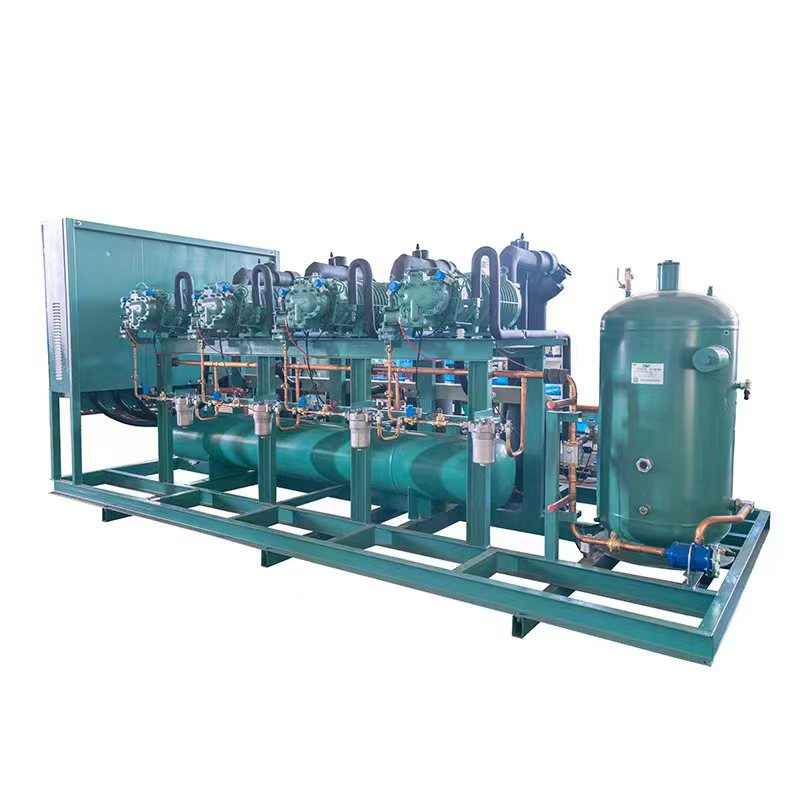

Recommended Products

Walk-in Cooler & Freezer, Cold Storage Warehouse

Custom Walk-in Refrigerator Cooler Freezer Food Storage Containers Cold Room

Custom Application Specific Walk in Coldroom For Sale

Walk in coldroom store logistic warehouse blast freezer cold storage room for meat fish fruit and vegetable

Cooling System Cold Storage panel Coldroom solar powered for fruits meat fish

Cold Room Price For Meat Fruits Vegetables Fish Portable Cold Rooms