




Advantages of VRF Systems
 Aug 01, 2026|
 View:174
Core Difference: Operating Principle & System Architecture
The fundamental difference is that VRF (Variable Refrigerant Flow) is a variable-capacity "multi-split" system, whereas traditional AC systems mostly operate on a simple "ON/OFF" basis.
In short, traditional ACs (e.g., residential split units or large chilled-water systems) usually run at fixed power and cycle on/off to maintain temperature. VRF, in contrast, works like a continuously variable transmission (CVT) vehicle—it precisely adjusts its "power output" based on real-time demand, achieving higher efficiency and comfort.
| Aspect | VRF System | Traditional AC System |
|---|---|---|
| Core Principle | Uses refrigerant directly as the heat-transfer medium. Employs inverter-driven compressors to modulate refrigerant flow rate according to load. | Mostly fixed-speed systems that start/stop compressors cyclically; or chilled-water/air-handling systems that involve secondary heat exchange. |
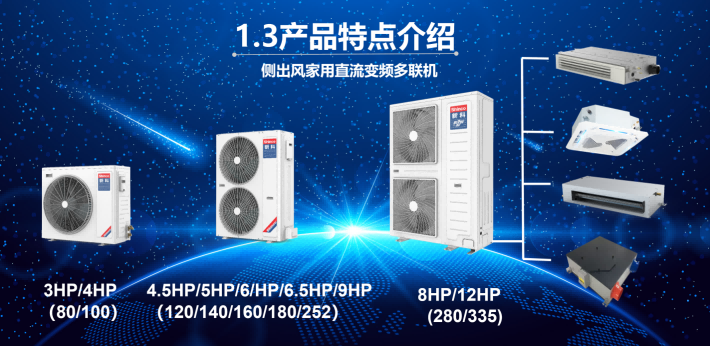
| System Composition | "One-to-Many" structure: one outdoor unit can connect to multiple indoor units (up to 64), each independently controllable. | "One-to-One" (split systems) or centralized (large water-cooled systems with cooling towers, pumps, and extensive piping/ductwork). |
Key Advantages of VRF Systems
Based on the above differences, VRF offers these significant benefits:
Outstanding Energy Efficiency – This is the biggest advantage. VRF uses inverter technology to operate efficiently at partial loads, avoiding the huge energy waste caused by the "full-capacity start/stop" cycling of traditional systems. Compared to conventional HVAC systems, VRF can save 20% to 40% of energy consumption.
Precise Comfort & Individual Control – Each indoor unit can be set to a different temperature and fan speed, satisfying diverse occupant preferences. Inverter technology ensures tight temperature control with minimal fluctuation (±0.5°C), and many VRF systems support dehumidification without overcooling—a great benefit during humid seasons.
Space Savings – VRF uses refrigerant piping instead of the bulky chilled-water loops (with pumps and pipe chases) or the massive air ducts required by all-air systems. This significantly reduces the space needed for mechanical rooms, pipe shafts, and ceiling plenums, and lowers floor-to-floor height requirements.
Flexible Design & Installation – A wide variety of indoor unit styles are available (wall-mounted, concealed ducted, ceiling cassette, floor-standing, etc.), accommodating different interior designs. Refrigerant piping can run for relatively long distances with moderate height differences, making VRF excellent for retrofitting old buildings or spaces with complex layouts.
Quiet Operation – Because the compressor seldom runs at full speed (thanks to inverter modulation), and indoor units are designed for low noise, VRF systems provide a much quieter indoor environment.


Recommended Products

Walk-in Cooler & Freezer, Cold Storage Warehouse

Custom Walk-in Refrigerator Cooler Freezer Food Storage Containers Cold Room

Custom Application Specific Walk in Coldroom For Sale

Cooling System Cold Storage panel Coldroom solar powered for fruits meat fish

Walk in coldroom store logistic warehouse blast freezer cold storage room for meat fish fruit and vegetable

Cold Room Price For Meat Fruits Vegetables Fish Portable Cold Rooms

Cold Storage Blast Freezer Room Walk In Cooler Storage Room For Meat

build & design Commercial Industrial Cold Storage room

Vegetable and Fruit Fresh-keeping Cold Room | Refrigerator Storage Room | Freezer Room Unit

Automatic Cold Storage Room Cool Freezing Refrigeration Freeze Cold Room


Recent News
1.Intelligent three - dimensional freezer has the following major characteristics
2019-10-282.Cold storage can be divided into the following types according to the structure of the storage body
2019-10-283.Main points of removing peculiar smell in cold storage
2019-10-284.Double - temperature cold room needs regular maintenance
2019-10-285.The process of freezing food
2019-10-286.Cold storage installation easy to be ignored
2019-10-287.Condenser action
2019-10-318.Compressor and condenser matching and selection
2019-10-319.Notes for compressor oil
2019-10-3110.Summary of common problems of Polyurethane Cold Room
2020-01-02