




Cold Storage Compressors: Core Knowledge for Efficient Refrigeration Systems
 Sep 01, 2025|
 View:1548
Advantages: Mature technology, strong adaptability to working conditions, and easy maintenance. They are suitable for small and medium-sized cold storage (with a cooling capacity of less than 100kW) and can handle various refrigerants (such as R22, R404A, and R507A).
Disadvantages: Large volume, high noise, and relatively low efficiency at partial loads.
Advantages: Compact structure, low noise, high efficiency (especially at partial loads), and large cooling capacity. They are widely used in large-scale cold storage (cooling capacity above 100kW) and industrial refrigeration systems.
Disadvantages: High manufacturing precision requirements and relatively high maintenance costs.
Advantages: Ultra-low noise, small size, high energy efficiency ratio (EER), and stable operation. They are ideal for small cold storage (e.g., convenience store freezers, small pharmaceutical cold storage) and scenarios with strict noise requirements.
Disadvantages: Poor resistance to liquid impact (easy to damage if refrigerant liquid enters the cylinder) and limited cooling capacity (mostly below 50kW).
Compression Stage: The compressor sucks in low-temperature (e.g., -15°C to -5°C) and low-pressure (e.g., 0.2MPa to 0.5MPa) refrigerant vapor from the evaporator (installed inside the cold storage). It then compresses the vapor to high-temperature (e.g., 40°C to 60°C) and high-pressure (e.g., 1.5MPa to 2.5MPa) vapor.
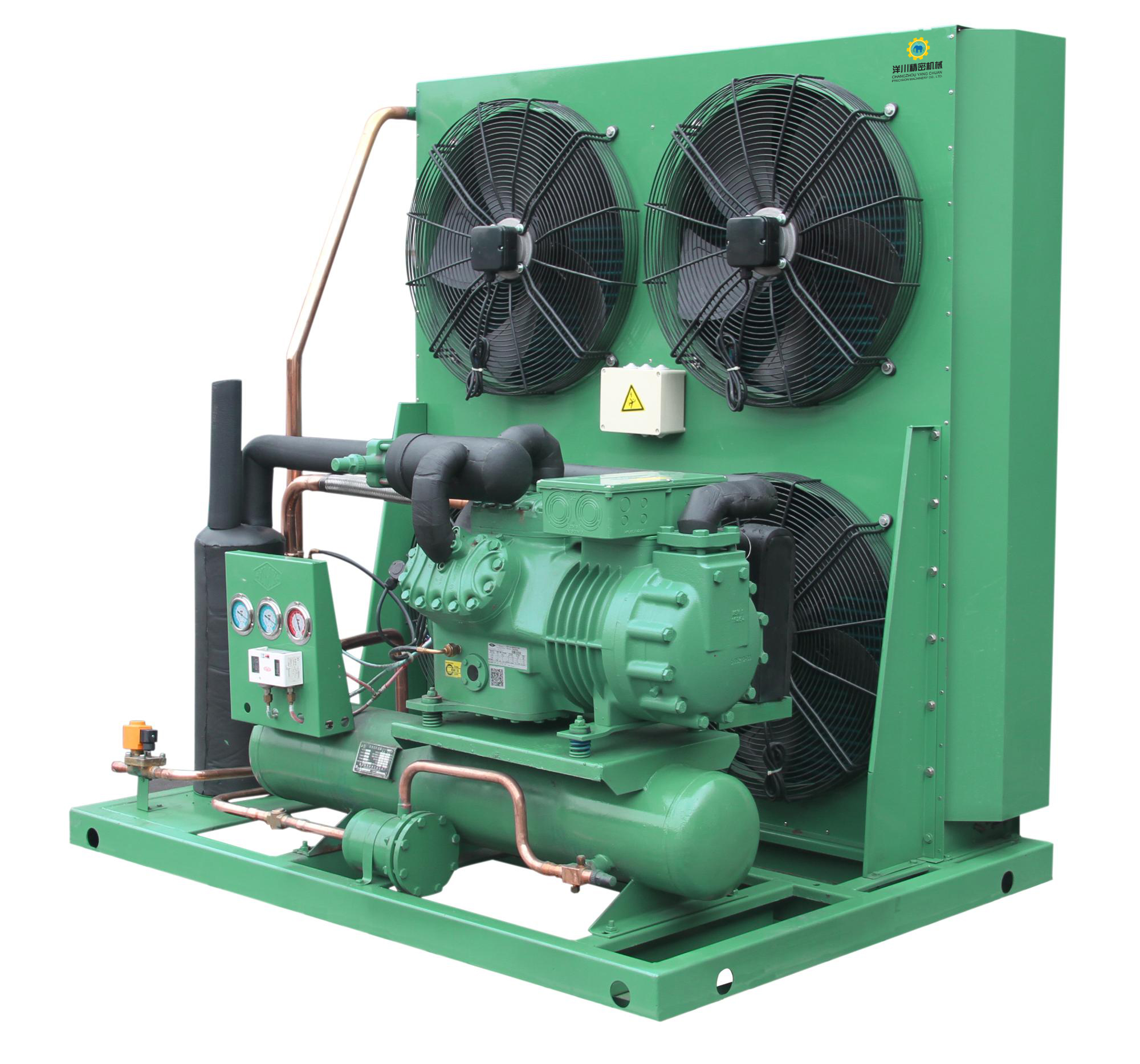
Condensation Stage: The high-temperature and high-pressure refrigerant vapor is sent to the condenser (usually installed outdoors or in a well-ventilated area). Here, the vapor releases heat and condenses into high-pressure liquid refrigerant.
Throttling Stage: The high-pressure liquid refrigerant passes through a throttle valve (or expansion valve), where its pressure and temperature drop rapidly, forming a low-temperature and low-pressure liquid-vapor mixture.
Evaporation Stage: The low-temperature mixture enters the evaporator, where it absorbs heat from the cold storage environment (lowering the storage temperature) and evaporates into low-pressure vapor. The vapor is then sucked back into the compressor, and the cycle repeats.
Heat from the stored goods (e.g., fresh meat cooling, fruit respiration).
Heat infiltration from the outside (through walls, doors, and roofs).
Heat generated by internal equipment (e.g., fans, lights).
Chilled storage (-5°C to 10°C): Low-pressure ratio, suitable for scroll or small reciprocating compressors.
Freezing storage (-18°C to -30°C): High-pressure ratio, twin-screw compressors (with economizers for energy saving) are preferred.
Ultra-low temperature storage (-40°C to -60°C): Special screw compressors (with two-stage compression) or cascade refrigeration systems.
Traditional refrigerants: R22 (gradually phased out due to ozone depletion potential).
Environmentally friendly refrigerants: R404A (common in freezing storage), R507A (alternative to R22), and R717 (ammonia, high efficiency but toxic, suitable for large industrial cold storage).
Screw compressors have a higher EER at partial loads (suitable for cold storage with fluctuating heat loads).
Inverter-driven compressors (adjusting speed based on cooling demand) can save 20%-30% energy compared to fixed-speed models.
Check the oil level in the compressor’s oil sump (should be between the "high" and "low" marks). Low oil levels cause insufficient lubrication, while high levels lead to oil carry-over (reducing heat exchange efficiency).
Replace the lubricating oil every 6-12 months (or as per the manufacturer’s recommendation). Deteriorated oil (dark color, impurities) increases friction and wear.
Clean the condenser (monthly for outdoor units) to remove dust, leaves, and dirt. Blocked condensers increase the compressor’s discharge pressure, leading to overheating and energy waste.
Clean the evaporator coil (quarterly) to prevent frost buildup (frost reduces heat absorption capacity, forcing the compressor to work harder).
Regularly check the suction pressure, discharge pressure, and temperature of the compressor. Abnormal values (e.g., too high discharge pressure, too low suction temperature) indicate potential issues (e.g., blocked throttle valve, refrigerant leakage).
Check the tightness of electrical connections (loose connections cause overheating).
Inspect the motor’s insulation resistance (to prevent short circuits) and the operation of safety devices (e.g., high-pressure switches, thermal protectors).
 |  | 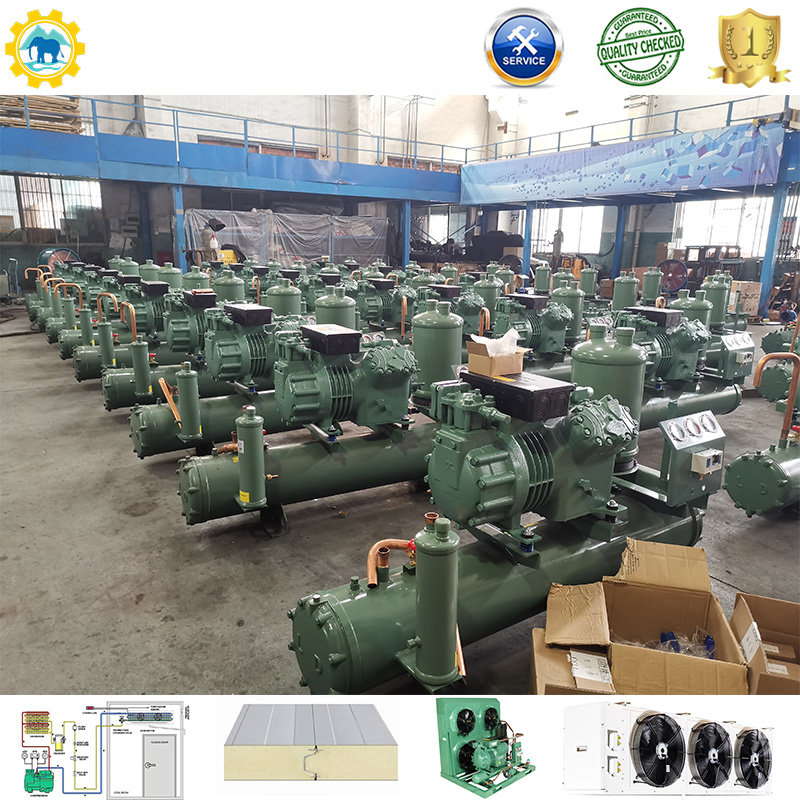 |
Conclusion
Cold storage compressors are critical for maintaining the stability and efficiency of cold storage systems. Understanding their types, working principles, selection criteria, and maintenance requirements is essential for both cold storage operators and refrigeration engineers. By choosing the right compressor and implementing regular maintenance, one can minimize energy consumption, reduce operating costs, and ensure the safe storage of goods.
Professional Cold storage room manufacturers, Complete Solutions.
Cold storage sandwich panels, cold storage doors and cold storage equipments are provided in complete package!! WeChat/Phone/WhatsApp:+86 15295113289 Chloe


Recommended Products

Walk-in Cooler & Freezer, Cold Storage Warehouse

Custom Walk-in Refrigerator Cooler Freezer Food Storage Containers Cold Room

Custom Application Specific Walk in Coldroom For Sale

Cooling System Cold Storage panel Coldroom solar powered for fruits meat fish

Walk in coldroom store logistic warehouse blast freezer cold storage room for meat fish fruit and vegetable

Cold Room Price For Meat Fruits Vegetables Fish Portable Cold Rooms

Cold Storage Blast Freezer Room Walk In Cooler Storage Room For Meat

build & design Commercial Industrial Cold Storage room

Vegetable and Fruit Fresh-keeping Cold Room | Refrigerator Storage Room | Freezer Room Unit

Automatic Cold Storage Room Cool Freezing Refrigeration Freeze Cold Room


Recent News
1.Intelligent three - dimensional freezer has the following major characteristics
2019-10-282.Cold storage can be divided into the following types according to the structure of the storage body
2019-10-283.Main points of removing peculiar smell in cold storage
2019-10-284.Double - temperature cold room needs regular maintenance
2019-10-285.The process of freezing food
2019-10-286.Cold storage installation easy to be ignored
2019-10-287.Condenser action
2019-10-318.Compressor and condenser matching and selection
2019-10-319.Notes for compressor oil
2019-10-3110.Summary of common problems of Polyurethane Cold Room
2020-01-02