




Working Principle of Vacuum Freeze Dryer
 Jul 01, 2026|
 View:102
Working Principle of Vacuum Freeze Dryer
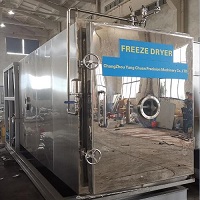
Vacuum freeze drying, also known as lyophilization, is a low-temperature dehydration process based on the principles of phase transition and coupled heat-mass transfer. Its core mechanism relies on the solid-gas two-phase equilibrium characteristics of water below the triple-point pressure (approximately 611 Pa), enabling the moisture pre-frozen within the material to sublimate directly from solid ice crystals into water vapor, thereby achieving deep dehydration without passing through the liquid phase.
The process can be systematically divided into the following three consecutive stages:
Pre-freezing Stage: The material is rapidly cooled to below its eutectic point temperature to ensure complete solidification of the internal moisture into ice crystals, establishing the necessary solid-phase substrate for subsequent sublimation.
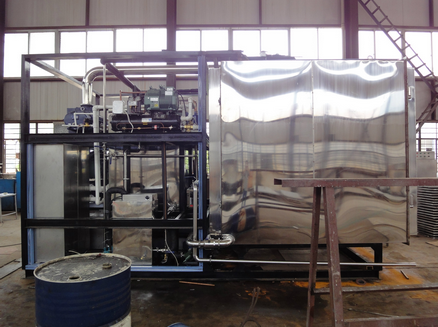
Primary Drying (Sublimation Drying): A vacuum pump evacuates the drying chamber to maintain an extremely low ambient pressure. Simultaneously, controlled heating is applied to provide the latent heat required for sublimation. Under these conditions, ice crystals directly transition into water vapor, which is then captured and condensed onto the surface of a much colder component—the cold trap (or water condenser)—thereby sustaining the vacuum level and driving the sublimation process forward.
Secondary Drying (Desorption Drying) : A fraction of bound water, which remains unfrozen due to its strong molecular association with the matrix, is removed through desorption at a slightly elevated temperature (typically not exceeding 60°C) under a higher vacuum level, achieving the final residual moisture content required for long-term preservation.
The refrigeration system plays a dual role throughout this process: it supplies the cooling capacity necessary for pre-freezing (quantified in tons of refrigeration in engineering practice), and it maintains the cold trap at an ultra-low temperature to effectively capture sublimated vapor, ensuring the continuity of both vacuum conditions and the drying process.
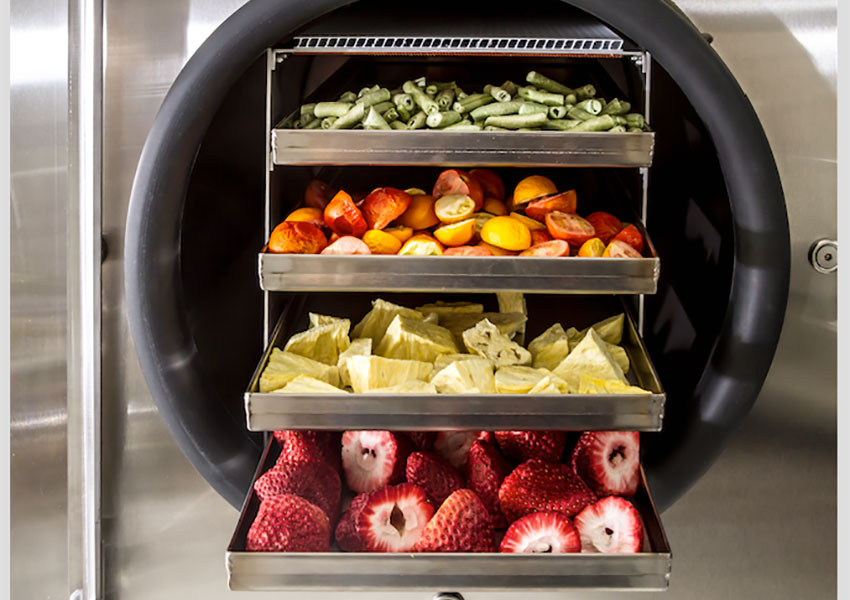
Compared to conventional thermal drying methods, vacuum freeze drying preserves the original structure, morphology, and biological activity of the product to the greatest extent. The resulting dried product exhibits a porous, sponge-like structure with excellent rehydration properties. Consequently, this technology is particularly suitable for heat-sensitive substances—including vaccines, blood products, enzymes, hormones, and other biologics—as well as pharmaceuticals and food products requiring long-term stability and preserved bioactivity.
 |  |

Recommended Products

Walk-in Cooler & Freezer, Cold Storage Warehouse

Custom Walk-in Refrigerator Cooler Freezer Food Storage Containers Cold Room

Custom Application Specific Walk in Coldroom For Sale

Cooling System Cold Storage panel Coldroom solar powered for fruits meat fish

Walk in coldroom store logistic warehouse blast freezer cold storage room for meat fish fruit and vegetable

Cold Room Price For Meat Fruits Vegetables Fish Portable Cold Rooms

Cold Storage Blast Freezer Room Walk In Cooler Storage Room For Meat

build & design Commercial Industrial Cold Storage room

Vegetable and Fruit Fresh-keeping Cold Room | Refrigerator Storage Room | Freezer Room Unit

Automatic Cold Storage Room Cool Freezing Refrigeration Freeze Cold Room


Recent News
1.Intelligent three - dimensional freezer has the following major characteristics
2019-10-282.Cold storage can be divided into the following types according to the structure of the storage body
2019-10-283.Main points of removing peculiar smell in cold storage
2019-10-284.Double - temperature cold room needs regular maintenance
2019-10-285.The process of freezing food
2019-10-286.Cold storage installation easy to be ignored
2019-10-287.Condenser action
2019-10-318.Compressor and condenser matching and selection
2019-10-319.Notes for compressor oil
2019-10-3110.Summary of common problems of Polyurethane Cold Room
2020-01-02