




Differences Between Freon and Ammonia Refrigeration
 Apr 01, 2026|
 View:295
Summary: Ammonia vs. Freon Refrigeration
1. Chemical Properties & Environmental Impact
Ammonia (R717):
Natural Refrigerant: ODP = 0, GWP = 0. Environmentally friendly.
Toxicity:Toxic (Class B2). Strong pungent odor detectable at 0.5% concentration.
Flammability:Flammable & Explosive (concentration between 15%–28% in air).
Freon (e.g., R22, R134a, R404A):
Synthetic Refrigerant: Traditional types (e.g., R22) deplete the ozone layer. Modern alternatives have zero ODP but often high GWP.
Toxicity:Non-toxic or mildly toxic (Class A1). Odorless, making leaks hard to detect.
Flammability: Typically non-flammable (though some new alternatives like R32 are mildly flammable).
2. Thermodynamic Efficiency
Ammonia:
High Efficiency: High latent heat of vaporization. Refrigerating capacity per unit volume is 1.5–2 times that of Freon. Systems are typically 15%–30% more energy-efficient than Freon systems.
Freon:
Lower Efficiency: Lower refrigerating capacity per unit volume compared to ammonia.
3. System Structure & Materials
Ammonia:
Materials: Corrosive to copper. Systems use seamless steel pipes exclusively.
System: Usually requires open-type compressors. The system is larger and requires a dedicated machine room with strict safety controls (gas alarms, emergency ventilation, water spray systems).
Freon:
Materials: Non-corrosive to metals. Typically uses copper pipes.
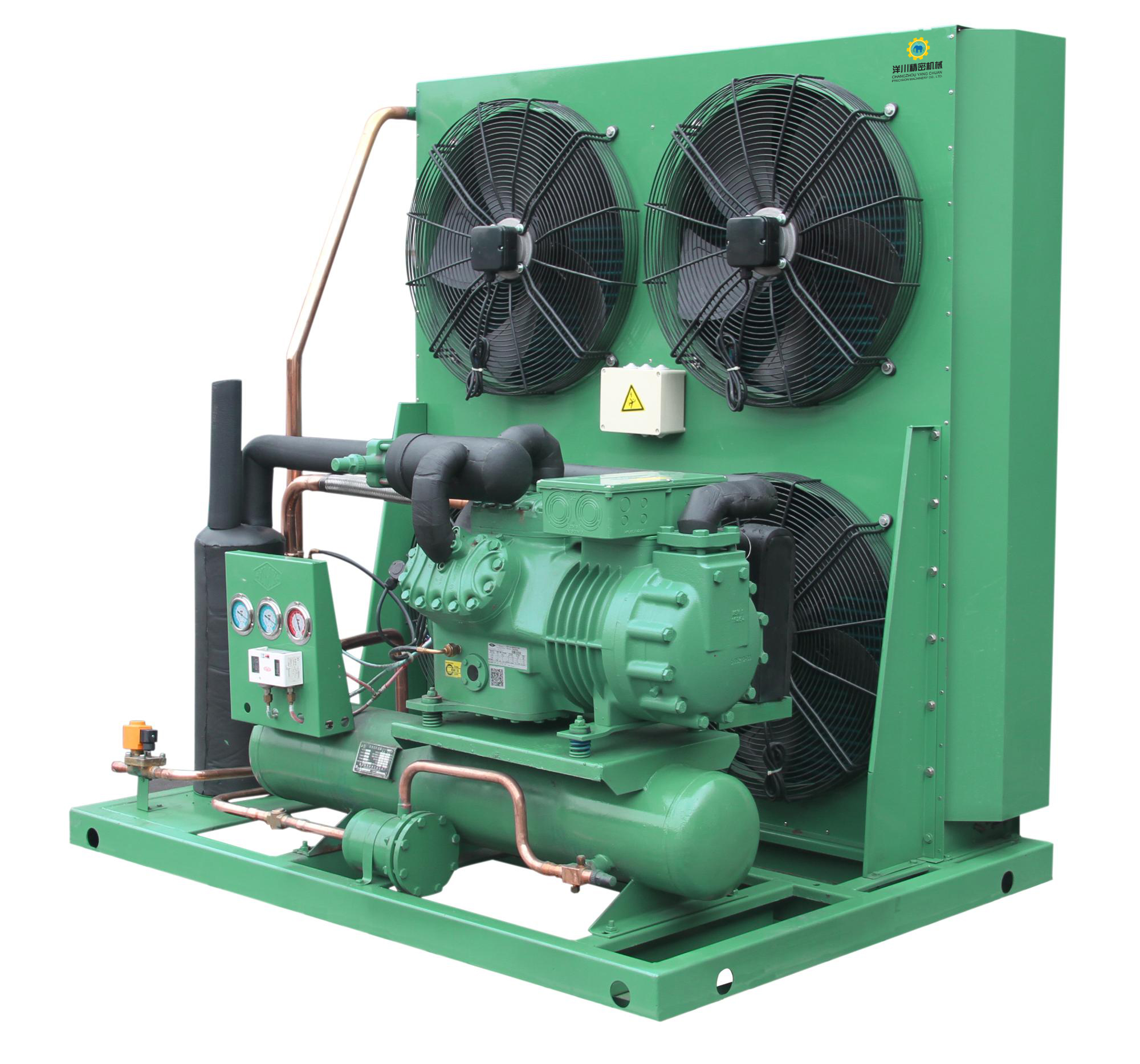
System: Compact and flexible. Often uses hermetic or semi-hermetic compressors. Modular designs allow installation on rooftops or small spaces, often without a dedicated machine room.
4. Safety & Regulations
Ammonia:
Classified as a Hazardous Chemical. Strict government regulations apply. Operators require special certification and must wear protective gear.
Risk of toxicity poisoning or explosion in the event of a large-scale leak.
Freon:
Not classified as a hazardous chemical (though subject to regulations regarding ozone depletion or global warming).
Lower regulatory burden. However, leaks in confined spaces can cause oxygen deprivation (suffocation risk).
5. Typical Applications
Ammonia:
Large-scale industrial refrigeration: Large cold storage facilities (tens of thousands of tons), food processing plants (meat, seafood, dairy), breweries, and chemical cooling.
Best suited for centralized systems, heavy loads, and continuous operation.
Freon:
Commercial, residential, and small-to-medium industrial applications: Supermarket display cases, small cold rooms, HVAC (air conditioning), refrigerated transport, household refrigerators.
Best suited for distributed systems, small-to-medium loads, and high automation (unattended operation) .
Final Recommendation
Choose Ammonia if you are building a large industrial cold storage facility where long-term energy savings are critical, and you have trained technicians on-site to manage safety protocols. (Modern NH₃/CO₂ cascade systems are a popular way to utilize ammonia's efficiency while minimizing the charge volume and risk.)
Choose Freon if you prioritize low safety risk, unattended operation, and a short installation timeline, particularly for commercial or small-to-medium projects.
Mr. Jack
Wechat/WhatsApp: +86 13961121309


Recommended Products

Walk-in Cooler & Freezer, Cold Storage Warehouse

Custom Walk-in Refrigerator Cooler Freezer Food Storage Containers Cold Room

Custom Application Specific Walk in Coldroom For Sale

Cooling System Cold Storage panel Coldroom solar powered for fruits meat fish

Walk in coldroom store logistic warehouse blast freezer cold storage room for meat fish fruit and vegetable

Cold Room Price For Meat Fruits Vegetables Fish Portable Cold Rooms

Cold Storage Blast Freezer Room Walk In Cooler Storage Room For Meat

build & design Commercial Industrial Cold Storage room

Vegetable and Fruit Fresh-keeping Cold Room | Refrigerator Storage Room | Freezer Room Unit

Automatic Cold Storage Room Cool Freezing Refrigeration Freeze Cold Room


Recent News
1.Intelligent three - dimensional freezer has the following major characteristics
2019-10-282.Cold storage can be divided into the following types according to the structure of the storage body
2019-10-283.Main points of removing peculiar smell in cold storage
2019-10-284.Double - temperature cold room needs regular maintenance
2019-10-285.The process of freezing food
2019-10-286.Cold storage installation easy to be ignored
2019-10-287.Condenser action
2019-10-318.Compressor and condenser matching and selection
2019-10-319.Notes for compressor oil
2019-10-3110.Summary of common problems of Polyurethane Cold Room
2020-01-02